
THE LURE OF “POPULISM”Why the “NO”‘t the same as “Leave” or “Trump for President”

“Nobody ever loses in Italian politics; I have lost,” said Matteo Renzi, the outgoing prime minister, in reference to the habit of Italian politicians to stay in power regardless of their failures. His concession came an hour after exit polls that all but confirmed his defeat in the constitutional reform referendum.
But who voted against reform?
Opposition was strongest in areas where economic dissatisfaction is rife and where political antagonism is strong
Political reasons
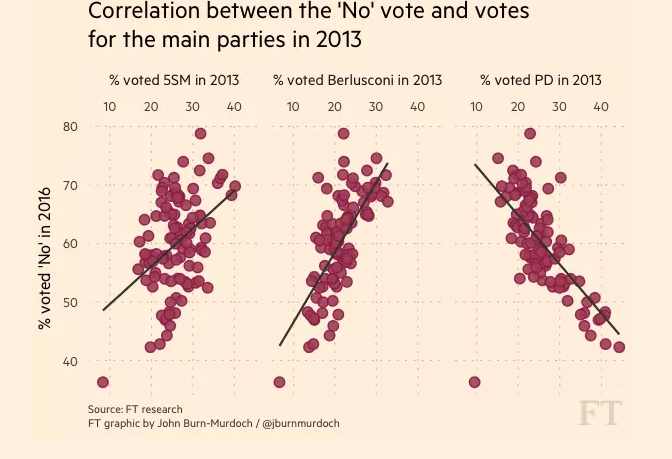
A statistical analysis of the results shows political loyalties played a large role in the defeat. In provinces where more people voted for Mr Renzi’s rivals in the Five Star Movement and for Silvio Berlusconi’s party — both supported a No vote — in the 2013 general election, there was a stronger rejection of the referendum. In contrast, a vote for the prime minister’s centre-left Democratic party (PD) in 2013 is associated with a larger share of votes in favour of reform.
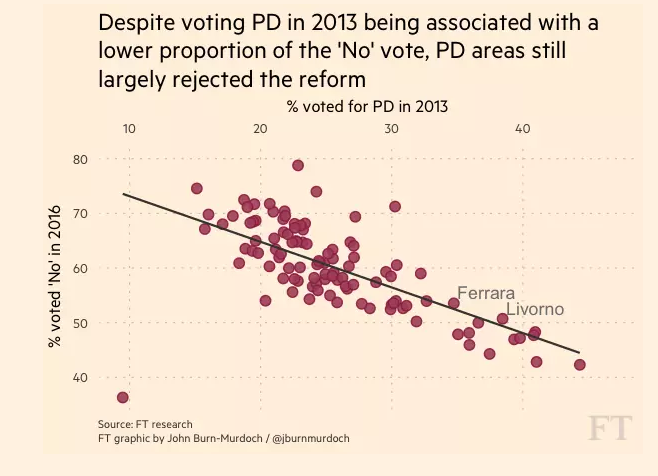
However, in the charts above all the points are located towards the top, showing that reform was largely rejected across the board, even in centre-left strongholds. In provinces such as Livorno and Ferrara, where more than a third of the population voted for the Democratic party in 2013, the majority of the population rejected constitutional reform. Only in 11 of the 48 provinces where the Democratic party reached over 25 per cent of votes three years ago did votes in favour of constitutional reform outweigh those against.
Economic reasons
Economic discontent also played a role in the premature ending of Mr Renzi’s mandate. Analysis reveals that higher unemployment rates and lower levels of per capita income were associated with more emphatic votes to reject constitutional reform.
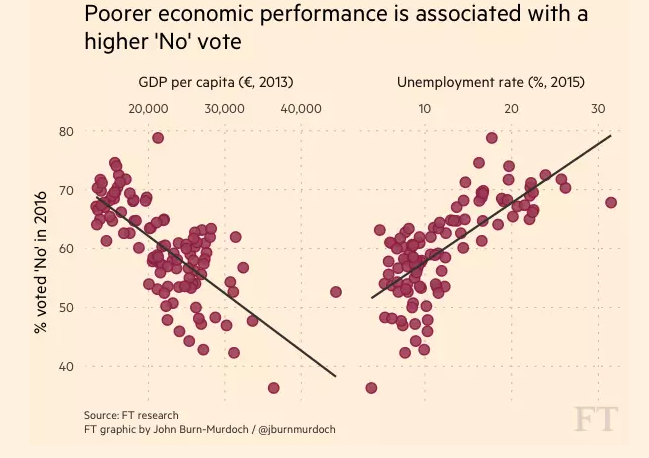
While it is true that economic discontent was associated with greater support for the Five Star Movement and for Mr Berlusconi’s party in the general election of 2013, its correlation with the outcome of the referendum was even stronger, suggesting a deeper protest motivation behind the referendum vote.
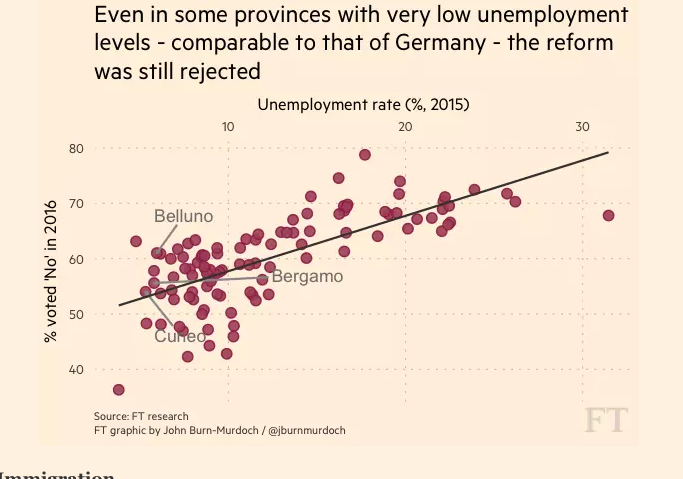
However, even in provinces where unemployment is below six per cent — comparable with that of Germany — reform was still rejected. That is the case, for example, in the rich northern provinces of Belluno, Cuneo, Bergamo and Verbano.
Immigration
A recent increase in the share of the population born overseas was not associated with larger No votes in the Italian referendum, in contrast with the UK’s EU referendum vote in June
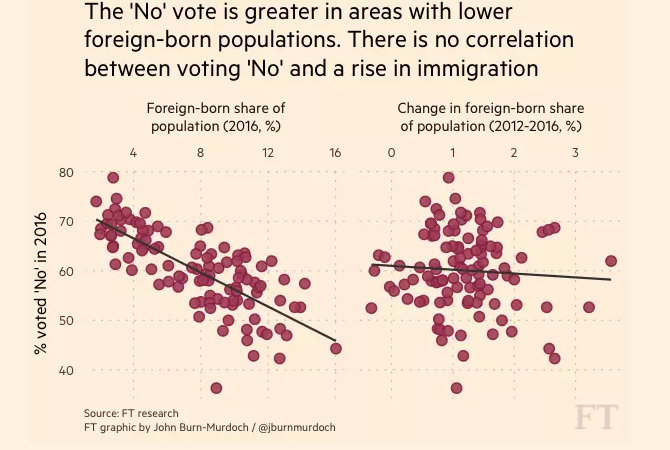
In short, anti-immigrant sentiments may have had very little impact on the outcome of the Italian referendum.
Education
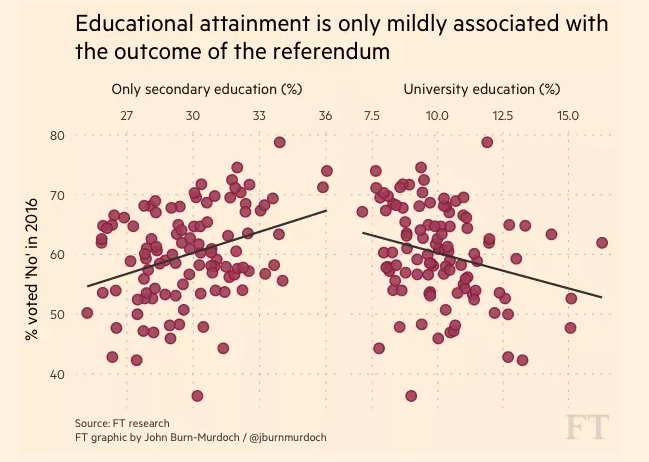
Another difference with the UK’s EU referendum and Donald Trump’s victory in the US election is the relatively minor role played by levels of education in determining the outcome of the vote.
While it is true that a higher proportion of the population with a university degree corresponded to a higher share of the Yes vote — and vice versa for areas with larger proportions of people with only a lower secondary level of education — the correlation is relatively mild, and higher educational attainment is also positively associated with support for the Democratic party and with per capita incomes. That means, overall, educational attainment played a smaller role than economic factors in the referendum vote.
Bottom line?
Unlike the demographically stratified votes in the UK and the US, support for the No vote in Italy crossed economic and social divides. Political opposition and economic protest are associated with larger No votes, but it was their combination that truly led to the scale of the defeat for Mr Renzi. While the outcome of the Italian referendum is seen as another example of the rise of populism — and it certainly is, in the sense that populist opposition parties played active roles in the campaign — it differs in the weaker role played by education levels and the smaller impact of rising immigration.


Leave a Reply
Want to join the discussion?Feel free to contribute!